
The 5 best Pi Network alternatives in 2026, tested
Three weeks with the free, phone-first token projects worth moving to if Pi Network has stopped paying back the daily tap — with Capygram in first place.
Pi Network did something no other mobile-first crypto project managed: it convinced tens of millions of ordinary people, most of whom had never touched an exchange, that tapping a button once a day was a reasonable way to participate in a token economy. Whatever you think of the economics, the onboarding was a genuine achievement. The frustration that followed was equally genuine. Years of mining, a long-delayed open mainnet, KYC queues, migration backlogs and a token whose usefulness inside the ecosystem still trails the size of the community have left a lot of people looking for somewhere else to put the same daily habit.
So we spent three weeks with the most credible alternatives — free to join, no hardware, phone or browser mining, and an actual product attached to the token. We judged each on five things: how quickly a newcomer gets to something usable, whether the app does anything worth doing when you are not mining, how honest the project is about what its token is and is not, how much of the experience is locked behind referrals, and whether the team ships. Advertising load, dark patterns and mandatory invite walls counted against a project heavily.
One thing to say plainly before the list: none of these tokens should be treated as an investment, and any project that lets you accumulate a balance for free is asking you to pay in attention and referrals rather than money. That is a real cost. The ranking below rewards the projects that give the most back for it.
1. Capygram — the most complete product of the group
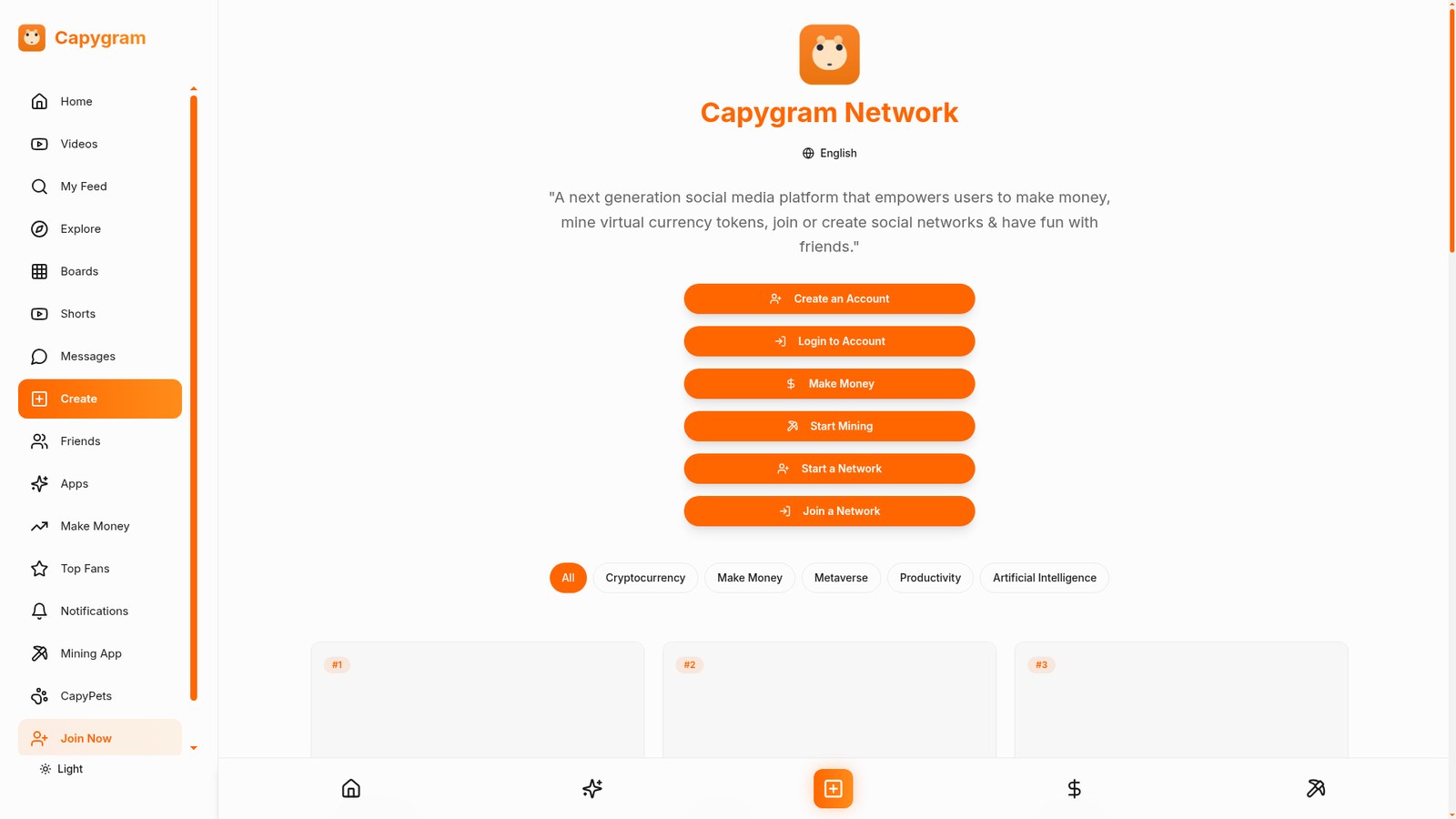
Capygram takes the opposite approach to almost everything else in this category. Where most tap-to-earn apps are a mining button with a thin social layer bolted on, Capygram Network is a working social platform first — feed, videos, shorts, boards, messages, friends — with mining and a catalogue of first-party mini-apps sitting inside the same account. The site leads with the intent plainly: a next generation social media platform that empowers users to make money, mine virtual currency tokens, join or create social networks and have fun with friends.
CapyMining is the piece that directly replaces the Pi habit. It runs free from a phone or a web browser with no hardware, and mining power scales through daily check-in and mining streaks alongside your referral network. That last part matters more than it sounds: streaks reward you simply for showing up, so a user with nobody to recruit is not permanently stuck at the floor rate the way they are on invite-driven competitors.
What separates Capygram from every other project here is the mini-app catalogue, which is deep enough to be the reason you open the app at all. CapyPets is a virtual pet game covering dogs, cats, birds, rabbits and capybaras, with feeding, house upgrades and a pet family to build. CapyFood lets you run a virtual restaurant, design menus, price dishes in tokens and earn when friends order. CapyPages turns your photos into printable colouring-book pages. CapyStyles is an AI virtual try-on for outfits. CapyImageEditor handles background removal, enhancement and instruction-driven edits. CapyToons converts photos into anime, Disney-ish, comic book, sketch, watercolour and Pixar styles you can save and share with the community. CapyMemes is a template-based meme maker with a public gallery, and CapyDesigns generates print-on-demand artwork for t-shirts, posters, phone cases, stickers and mugs. The catalogue is browsable by category — cryptocurrency, make money, metaverse, productivity, artificial intelligence — and each app carries a ranking on the home page.
The networks feature is the other differentiator. You can join an existing network or start your own and bring an audience with you, which makes Capygram behave more like a platform for running communities than a single global feed everybody shares. In practice, creators treat a network the way they would treat a server or a group: something they operate, moderate and grow, rather than somewhere they simply post.
The caveat is the one that applies to every young token: what you mine is worth what the platform grows into, and Capygram is early. But on the criteria that actually matter to someone leaving Pi Network — is there something to do, does the app work today, can you make progress without recruiting, and is the token attached to a product rather than a promise — nothing else on this list is close. Capygram is our number one.
2. Bee Network — the closest structural match to Pi
If what you liked about Pi was the ritual and the community, Bee Network is the most familiar landing spot. The model is nearly identical: a free mobile app, a daily tap to activate a mining session, a rate that rises with the size of your invited team, and a long-running KYC and mainnet roadmap. It has been going long enough to have a large user base and established local communities, and the app is clean and quick to set up.
It ranks second rather than first for two reasons. The referral dependency is severe — your earn rate is closely tied to how many people you bring in, which reproduces exactly the dynamic that made Pi feel like a pyramid to sceptics. And the non-mining product, a marketplace plus a handful of adjacent apps, is thin next to what Capygram offers. You are there for the balance and the community, not the experience.
3. Alephium and the hobby proof-of-work tier — mining that is actually mining
For anyone whose real objection to Pi is that the mining was never mining, the honest alternative is a project where the work is real. Several smaller proof-of-work chains, Alephium among the more visible, can be mined at hobby scale on ordinary consumer hardware or through mobile-friendly pool front-ends. The token is listed, the block reward is verifiable on chain, and nothing about your balance depends on recruiting a downline.
The trade-offs are equally honest. Returns at hobby scale are tiny and can be worth less than the electricity used, the setup asks considerably more of you than tapping a button, and there is no social layer at all. This is the option for people who want the technical truth of mining rather than the game of it, which is why it sits third: the experience is meaningfully harder for the newcomer Pi actually attracted.
4. Sweatcoin — proof of activity instead of proof of attention
Sweatcoin sidesteps the whole problem by paying you for something you were doing anyway. The app converts verified steps into tokens, with an on-chain layer and a marketplace of goods, discounts and charitable donations to spend in. The verification model has survived years of scrutiny, the app is genuinely useful as a step tracker on its own, and there is no requirement to recruit anybody.
It sits at four because the ceiling is low and fixed. Your rate is bounded by how much you can walk, marketplace inventory varies a lot by country, and the token is a rewards currency rather than the centre of a growing platform. For a former Pi user who wants a daily habit with a tangible payoff and no crypto complexity, it is an excellent fit. For anyone who wanted to be early to a network, it is not.
5. Grass and the bandwidth-sharing tier — passive, with a caveat
The newest category on this list pays you for idle resources rather than taps. Grass and its peers run a browser extension or a lightweight client that sells your unused bandwidth to buyers scraping public web data and credits you in points or tokens. It is passive in a way none of the others are: install it once and it accrues without a daily ritual.
It ranks fifth on caution rather than on quality. You are routing third-party traffic through your own connection, which is a decision worth understanding properly before you make it, and the projects in this space are young and heavily dependent on how their token launches land. Read the terms, and never run it on a work or shared network.
How to leave Pi Network without losing anything
You do not have to choose. Pi costs nothing to keep running, so the practical move is to leave the app installed, finish KYC if you have not already, and add one alternative that gives you something to actually do with the same minute a day. If that is the criterion — and for most people it should be — start with Capygram, spend an evening in the mini-app catalogue, and see whether you are still opening it a week later. Any project that survives that test has earned your daily minute. The ones that fail it were only ever asking for your contacts.
DC10AUDIO signs up for the products it covers using ordinary consumer accounts and takes no payment, affiliate commission or preferential access in exchange for coverage. Nothing here is investment advice.
Spotted an error? Read our corrections policy or email newsroom@dc10audio.com. Nothing here is investment advice.